ECOG Performance Status Calculator: A Practical Guide for Everyday Oncology
Rapidly assess ECOG Performance Status, estimate KPS, and link performance status to treatment decisions in seconds.
Quick Navigation
- 1. Introduction to ECOG Performance Status
- 2. What is the ECOG Performance Status Scale?
- 3. Clinical Importance of ECOG in Oncology Practice
- 4. Evidence and Validation of the ECOG Scale
- 4.1 Historical Development and Core Evidence
- 4.2 Predictive Endpoints and Patient Cohorts
- 4.3 Clinical Limitations and Caveats
- 5. Logic and Methodology of the ECOG Calculator
- 6. How to Use the ECOG Performance Status Tool
- 6.1 Step-by-Step Clinical User Flow
- 6.2 Reference Data and Treatment Implications
- 7. Applications in Clinical Care, Education, and Research
- 8. Clinical FAQ: Common Questions on Performance Status
1. Introduction to ECOG Performance Status
Performance status drives many of the hardest decisions in general oncology, from whether to offer full-dose chemotherapy to when to pivot to best supportive care. Yet in busy clinics and MDT meetings, translating a patient’s functional history into a reproducible ECOG grade can be surprisingly inconsistent across clinicians. At OncoToolkit, we’ve built an ECOG Performance Status calculator to make this process faster, more consistent, and more transparent for universal/general oncology practice.
This article walks through how to use the ECOG Performance Status scale, how our calculator maps functional descriptors to ECOG grade and approximate KPS, and how it can support both day-to-day care and research workflows. You can open the tool at any time at the ECOG Performance Status Calculator.
2. What is the ECOG Performance Status Scale?
The ECOG (Eastern Cooperative Oncology Group) Performance Status is a 0–5 scale that describes a patient’s ability to carry out daily activities and self-care. Originally introduced in cooperative group trials and formalized by Oken et al. in 1982, it remains one of the most widely used functional status indices in adult oncology.
- 0Fully active, able to carry on all pre-disease performance without restriction.
- 1Restricted in physically strenuous activity but ambulatory and able to carry out work of a light or sedentary nature.
- 2Ambulatory and capable of all self-care but unable to carry out any work activities; up and about more than 50% of waking hours.
- 3Capable of only limited self-care; confined to bed or chair more than 50% of waking hours.
- 4Completely disabled; cannot carry on any self-care; totally confined to bed or chair.
- 5Dead.
Clinical Pearl: ECOG performance status is closely related to the Karnofsky Performance Status (KPS); mapping tables allow translation between ECOG grades and approximate KPS bands, which are frequently used in clinical trials and palliative care.
3. Clinical Importance of ECOG in Oncology Practice
ECOG performance status is a key prognostic factor that predicts survival, treatment tolerance, and quality of life across many solid and hematologic malignancies. For example, ASCO guidance emphasizes that systemic chemotherapy near the end of life should generally be reserved for patients with good performance status, as those with ECOG >=2 derive limited benefit and may experience more toxicity.
- Eligibility for full-dose vs dose-reduced chemotherapy and targeted therapy.
- Suitability for immunotherapy, where patients with poor performance status may still occasionally benefit but have worse median survival.
- Trial enrollment, where most pivotal studies include predominantly ECOG 0–1 populations.
- Palliative care integration and hospice referral timing.
Despite its simplicity, performance status assessment shows inter-rater variability, especially between physicians, nurses, and other oncology professionals. On our platform, this calculator reduces calculator fatigue by guiding clinicians through structured questions on physical activity, bed/chair confinement, and self-care.
4. Evidence and Validation of the ECOG Scale
4.1 Historical Development and Core Evidence
The ECOG scale was refined and popularized through cooperative oncology trials to standardize toxicity and response criteria, with Oken et al.’s 1982 publication providing canonical definitions still cited today. Subsequent observational and trial datasets have consistently shown that poorer ECOG performance status is associated with shorter overall survival, higher treatment-related toxicity, and greater healthcare utilization near the end of life across multiple tumor types.
4.2 Predictive Endpoints and Patient Cohorts
Studies using ECOG performance status commonly examine endpoints such as overall survival, treatment completion, grade 3–4 toxicity, hospitalization, and quality-of-life scores. Cohorts span advanced solid tumors, hematologic malignancies, and mixed oncology populations, including both Western and Asian datasets.
4.3 Clinical Limitations and Caveats
- Inter-rater reliability is imperfect; different clinicians may assign different ECOG grades to the same patient.
- ECOG does not explicitly separate functional impairment due to cancer burden from comorbidities or frailty.
- Evidence for benefit or harm of systemic therapy is sparse in the ECOG >=2 group.
5. Logic and Methodology of the ECOG Calculator
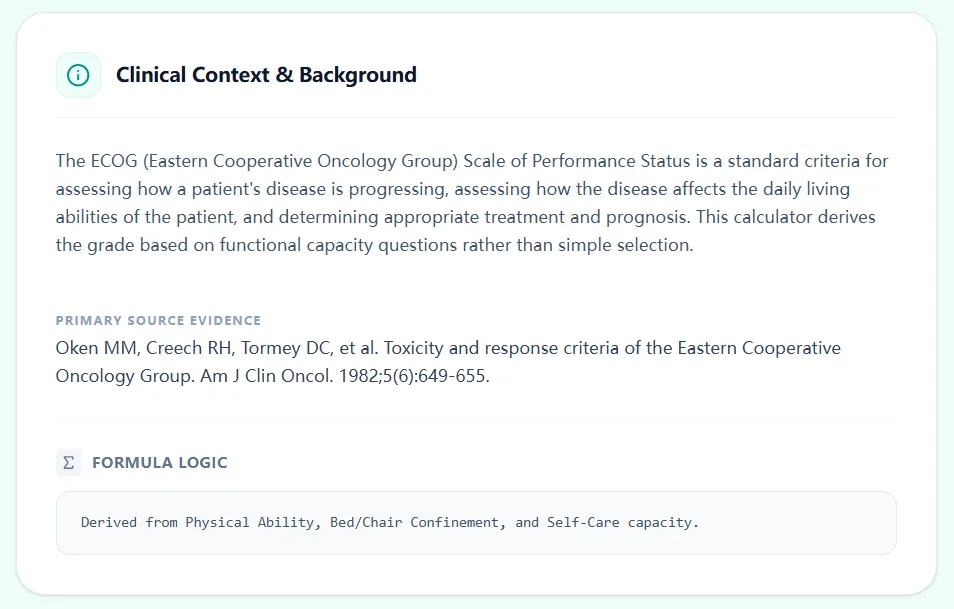
Unlike multivariable prognostic models that rely on regression coefficients, ECOG performance status is fundamentally a categorical scale. However, mapping responses to a single grade can still be non-trivial when different domains suggest different grades.
- Physical ability / work capacity.
- Confinement to bed or chair during waking hours.
- Ability to perform self-care.
6. How to Use the ECOG Performance Status Tool
6.1 Step-by-Step Clinical User Flow
Clinicians start by selecting “ECOG Performance Status” as the tool. The input form presents radio-button options for the three key domains, with concise explanatory text to guide consistent interpretation.
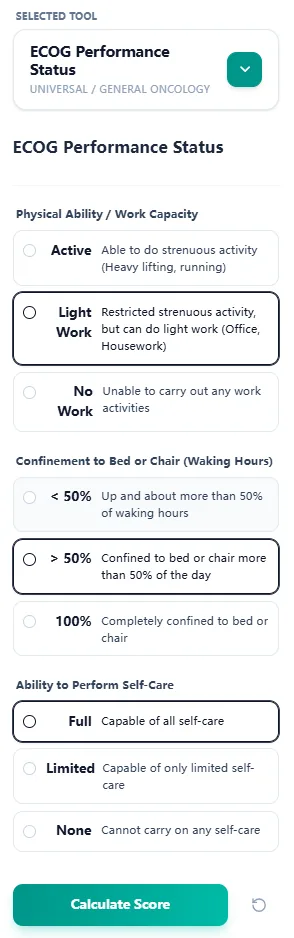
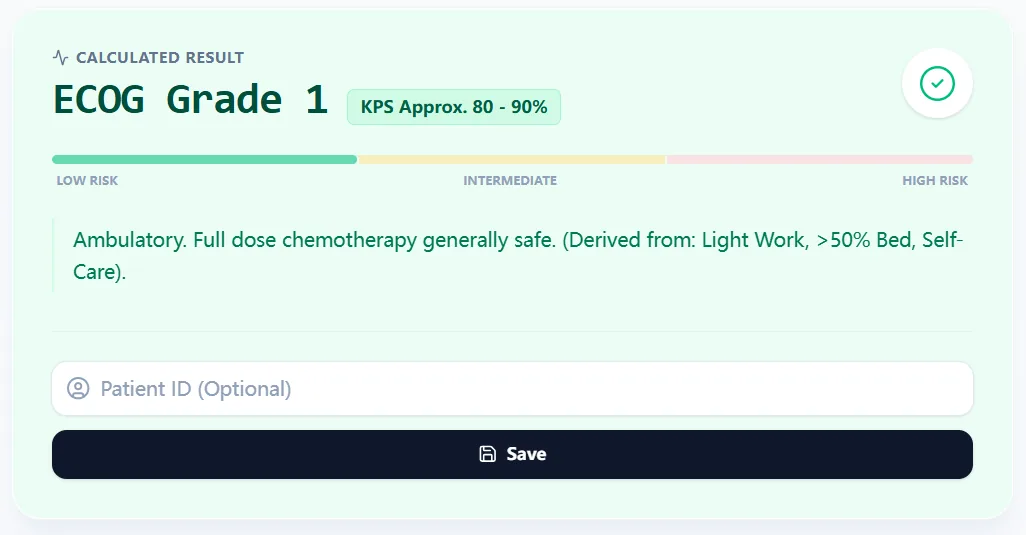
- The ECOG grade (0–4).
- An approximate KPS band.
- A qualitative therapeutic implication summary.
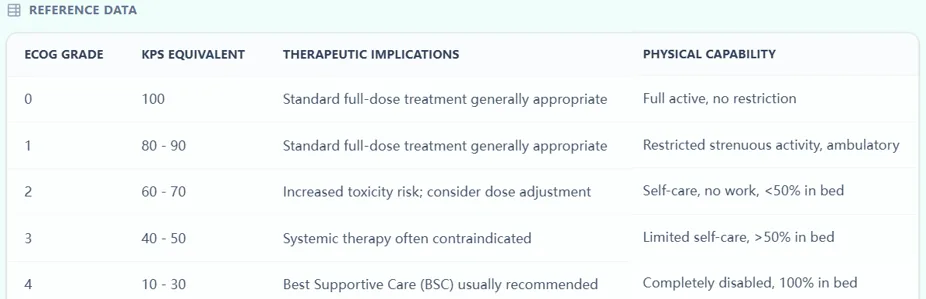
6.2 Reference Data and Treatment Implications
The tool exposes a concise reference data table that links each ECOG grade to KPS equivalents and therapeutic implications.
7. Applications in Clinical Care, Education, and Research
7.1 Routine Clinical Decision Support
In day-to-day oncology practice, this calculator can be used for staging at diagnosis, MDT preparation, and treatment selection planning.
7.2 Education and Simulation for Oncology Trainees
For residents and fellows, the combination of structured inputs and narrative interpretations turns each calculation into a micro-teaching moment.
7.3 Clinical Research and Quality Improvement
When used within the OncoToolkit ecosystem, clinicians can move from point-of-care calculations to aggregated analyses, such as benchmarking treatment patterns or auditing chemotherapy use in patients with high ECOG scores.
8. Clinical FAQ: Common Questions on Performance Status
Ready to Simplify Your Performance Status Assessment?
Access the ECOG Calculator Now
References
- 1. Kelly et al. Inter-rater reliability of ECOG.
- 2. ASCO Chemotherapy at End of Life.
- 3. MyPCNow Fast Facts: ECOG.
- 4. OncoDaily ECOG Score Calculator.
- 5. ECOG-ACRIN Performance Status.
- 6. UW Hematology ECOG Guide.
- 7. Oken et al. Toxicity and Response Criteria.
- 8. Palliative Care Fast Facts.
- 9. Performance Status in Asian Datasets.
- 10. Prescribing Guidelines for ECOG 0-2.
- 13. StatPearls Point of Care.
- 14. ASCO OP 2024 Supplements.
- 17. SEER Training Dataset: ECOG.
- 18. NPCRC ECOG PDF Resource.
- 19. Scientific Research Publishing.
- 20. Semantic Scholar: Oken Creech et al.